|
The Coupe d'Aviation Maritime
Jacques Schneider, commonly called the Schneider Trophy or
Schneider Prize (sometimes it is incorrectly referred to as the
Schneider Cup, which is entirely different prize), was a trophy
awarded annually to the winner of a race for
seaplanes and flying boats.
The Schneider Trophy is now held at the Science Museum, South
Kensington, London.
Announced by Jacques Schneider,
a financier, balloonist and aircraft enthusiast, in 1912, the
competition offered a prize of approximately £1,000. The race
was held twelve times between 1913 and 1931. It was intended to
encourage technical advances in civil aviation but became a
contest for pure speed with laps over a (usually) triangular
course (initially 280 km, later 350 km). The contests were
staged as time trials, with aircraft setting off individually at
pre-agreed times, usually 15 minutes apart. The contests were
very popular and some attracted crowds of over 200,000
spectators. An earlier trophy, also presented by Jacques
Schneider in 1910, in France, was the Schneider Cup, which is
held in the RAF College Cranwell.
If an aero club won three races in five years, they
would retain the trophy and the winning pilot would receive
75,000 francs for each of the first three
wins. Each race was hosted by the previous winning country. The
races were supervised by the Fédération Aéronautique Internationale and the
aero club in the hosting country. Each club could enter up to
three competitors with an equal number of alternatives.
The race was significant in advancing aeroplane design,
particularly in the fields of aerodynamics
and engine design, and would show its results in the best
fighters of WW2. The streamlined shape
and the low drag, liquid-cooled engine pioneered by Schneider
Trophy designs are obvious in the British Supermarine Spitfire, the
American North American P-51 Mustang, and
the Italian
Macchi C.202
Folgore.
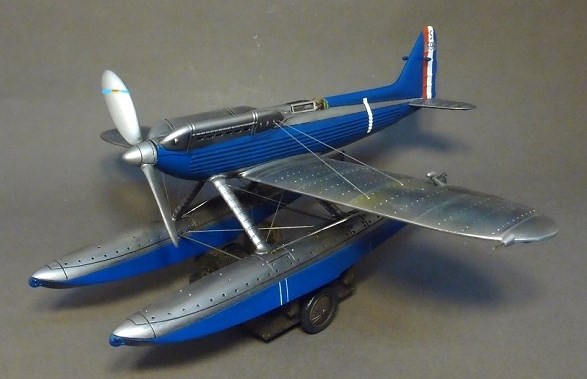
The Supermarine S.6B is a British racing seaplane
developed by R.J. Mitchell
for the Supermarine
company to take part in the Schneider Trophy
competition of 1931. The S.6B marked the culmination of
Mitchell's quest to "perfect the design of the racing seaplane"
and represented the cutting edge of aerodynamic technology.
The
last in the line developed by Supermarine, it followed the
S.4, S.5 and the
S.6. Mitchell and his team's experience
in designing high speed Schneider Trophy floatplanes greatly
contributing to the development of the later Supermarine Spitfire, an iconic
fighter and Britain's most successful interceptor of World War
II.
The winning Schneider flight was piloted by Flt. Lt.
John N. Boothman in aircraft serial number
S1595 at a speed of 340.08 mph (547.19 km/h), flying seven
perfect laps of the triangular course over the Solent, between
the Isle of Wight and the British mainland.
Seventeen days later, Flt Lt.
George Stainforth
in S.6B serial S1596 broke the world
air speed record reaching
407.5 mph (655.67 km/h). |